
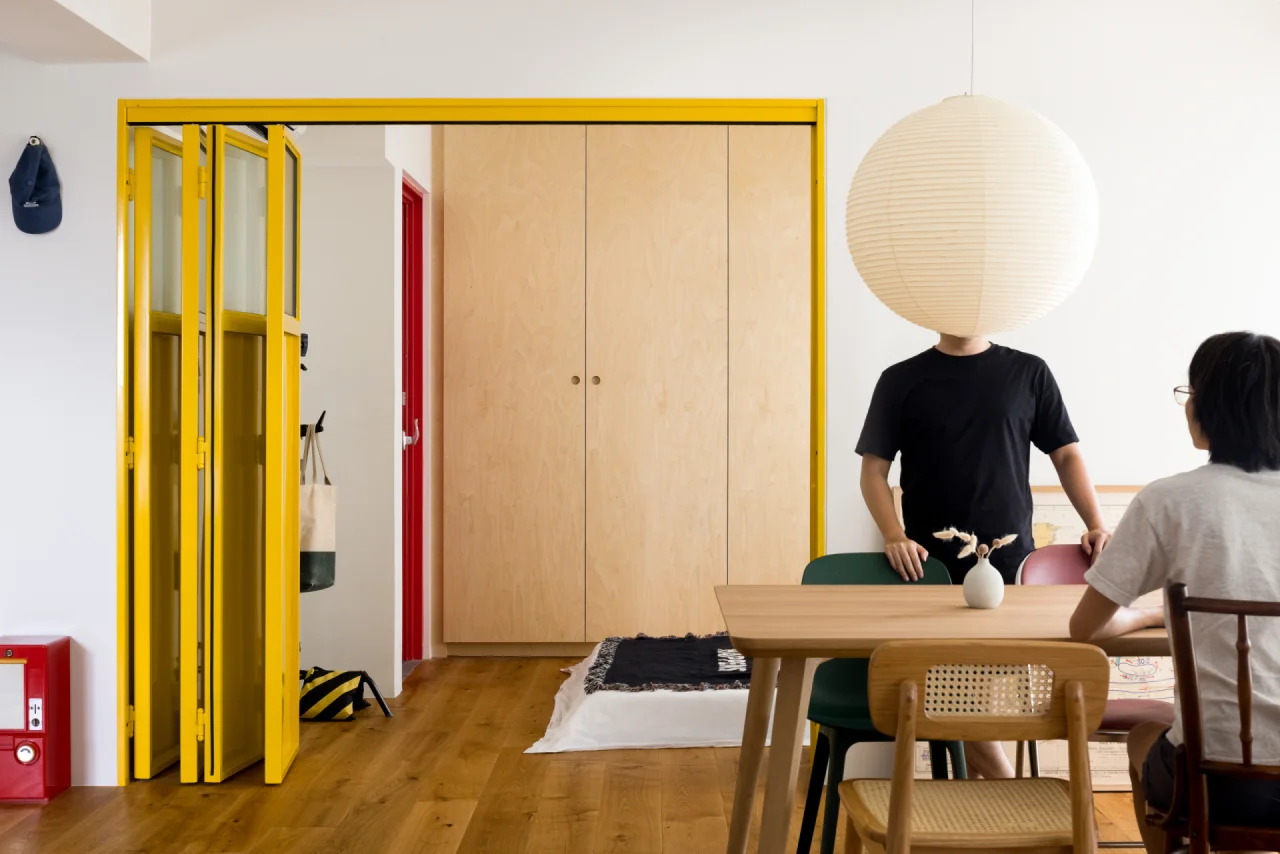
In Singapore homes the most successful eclectic schemes anchor bold moments — a yellow door frame, a red-tiled bathroom, a navy feature wall or a blue-and-yellow games room — within a calm base of timber and neutral surfaces, with plenty of closed storage.
Typical material direction: colour-blocked joinery and doors, glazed and patterned tiles, primary and jewel-tone paints, terrazzo, mixed metals, graphic wall treatments and display shelving.
Structured boldness
A calm base makes the colour sing
Neutral floors, timber carpentry and white or greige walls give the scheme a backbone. Colour is then placed with purpose: framing an opening, zoning an area, or turning a bathroom or feature wall into a statement.
Repeating two or three colours across the home — in a door, a tile and a piece of furniture — ties different rooms together.
Personal & practical
Display what you love, store the rest
Collections, art, games and hobbies are part of the design: display niches, pegboards and open shelves give them a home, while closed storage keeps everyday items out of sight.
Durable finishes matter with strong colour — glazed tiles, quality laminates and washable paints keep bold surfaces looking fresh.
Material palette
Choose tactile materials with a maintenance plan
Anchor bold moments with durable materials: glazed and patterned tiles, colour-matched laminates, washable paints and terrazzo. Choose two or three signature colours — for example yellow, red and cobalt blue — and repeat them across doors, joinery, tiles and furniture so the home feels connected.
Material samples should be viewed in both daylight and artificial light. Batch variation, joint lines, edge profiles and sealers can change the final effect, so the design should document not only the material name but also where it starts, stops and meets adjacent finishes.
Spatial planning
Let the floor plan carry the style
Give every bold element a job: a coloured door frame marks an entrance, a tiled wall zones a kitchen or bathroom, a painted room becomes a games or hobby space. Plan display niches and pegboards for collections alongside generous closed storage, so personality is on show without clutter.
Storage, door swings, furniture depth and circulation are resolved first. Decorative gestures then reinforce those decisions instead of competing with them. This is especially important in compact HDB and condo homes, where every additional full-height element changes daylight and perceived width.
Lighting guide
Use 2700K–3000K warm architectural light with layered control
For most living and hospitality-style residential zones, 2700K–3000K lighting supports a warm material palette without making timber or stone look orange. Combine ambient light with task and accent layers rather than relying on a dense grid of downlights. Colour rendering, beam angle, glare control and dimming are often more important than wattage alone.
Kitchen worktops, wardrobes, desks and artwork may need separate task or accent light. The lighting plan should be coordinated with ceiling details, air-conditioning grilles, sprinklers where applicable and carpentry so fixtures do not collide with doors or shelves.
Tropical performance
Adapt the material language to Singapore humidity
Saturated paints and glossy tiles show wear differently, so specify scrubbable paint systems and quality grout, and seal natural materials. Coloured laminates and powder-coated metals keep their colour better than site-painted finishes in humid, high-use areas.
Natural stone such as travertine can require sealing; timber and veneer need appropriate finishing and moisture control; limewash or mineral-style coatings depend on compatible substrates; and sintered stone still requires correct support, edge fabrication and joint detailing. A style is successful only when it remains practical after years of cleaning, air-conditioning and daily use.